

Mobile
2022
As the lead product designer driving this initiative, I kicked off an internal exploration of a new ‘comment dislike’ feature to capture negative user sentiment on Instagram. Partnering with a user researcher, content designer, and data scientist, I helped shape the research plan and draft the interview script. Additionally, I designed the dislike icon and prototype we tested with 20 creators across five countries. Through this cross-functional collaboration, we were able to uncover insights about how creators viewed comment sections associated with their posts and gather feedback on the desirability of the proposed design.
Due to the confidential nature of this work, I’m unable to share certain details or full documentation. I’m happy to discuss relevant learnings and approaches in more detail if requested.

Dislikes as a new input for deriving user sentiment and preferences
In 2022, TikTok began testing a comment dislike button that lets users privately flag comments they find irrelevant or inappropriate. As the PD lead for the Connection Safety team, I thought that this was something the team should also consider testing based on what I knew about similar features like Limits (comment restrictions) and Hidden Words.


The initial product ask
Initially, I went to the PM with a fuzzy request to work with some members of the team to explore how dislikes may exist on Instagram. I had no data or fleshed out proposal. So it is no surprise that I had no compelling answers to his questions around the purpose of the feature, how it differs from current reporting and what the scope of its development would be if we pursued an experiment.
I left that conversation with no clear yes or no decision. However, our PMs hesitant curiosity was just enough for me to continue exploring the idea. I knew that in order to make the experiment happen I would need to refine the ask with supporting evidence, and reframe the opportunity so that my request would resonate with the team and align with our goals.
Better understanding the problem
I started by finding internal and external data and product precedents around using negative user sentiment in a variety of contexts (in collaboration with the broader team). The goal was to better understand how other products capture negative user sentiment and use it to improve their offerings.
From this initial discovery work we identified three relevant issues in our current comment section:
Comment moderation is reactive
Currently, signals like reporting or muting are relatively high friction. They’re underused, especially for borderline harmful comments (snide remarks, micro-aggressions, subtle harassment).
Blind spots in detection
Our existing classifiers often fail on nuanced toxicity (sarcasm, coded language, light bullying). As a result, harmful experiences slip through.
Impact on trust & safety KPIs
Undetected toxic comments drive silent churn, reduced posting frequency, and reduced comment engagement—particularly among vulnerable user groups like teens.
Based on our understanding of prevailing issues with fostering productive comment threads, we developed the following working thesis for how a feature capturing negative sentiment involving comments could be used to improve how users connect with each other and engage with content.
Experiment thesis
Instagram has invested heavily in detecting and removing harmful comments, but lacks a lightweight way for users to identify comments that detract from conversations without violating platform policies. Introducing a private negative feedback signal could help close this gap, providing new insights into comment quality that could improve ranking, user satisfaction, and interactions between creators and their audiences.
Designing the experience
The design direction was influenced by the following principles:
Preserve a Positive Social Experience
Negative feedback should not introduce unnecessary negativity into the platform. Given Instagram's emphasis on positive social interactions and the contentious history of dislikes internally, we approached the design without presupposing a traditional dislike mechanism. Instead, we explored ways to capture negative sentiment privately and discreetly, without encouraging public judgment or antagonistic behavior.
Minimize Interaction Friction
Providing feedback should require minimal effort relative to the lightweight, high-volume nature of comments. We prioritized simple, immediate interactions that users could perform without interrupting their experience. Introducing additional steps risked turning the feature into a quasi-reporting mechanism, undermining its purpose as a lightweight signal of comment quality.
Keep Feedback Contextual
Feedback should be accessible at the moment and location where an undesirable comment is encountered. We prioritized placing the interaction in close proximity to individual comments, allowing users to respond directly to the content that prompted their reaction. This proximity would strengthen the relationship between the feedback and its target while reducing the effort required to act.
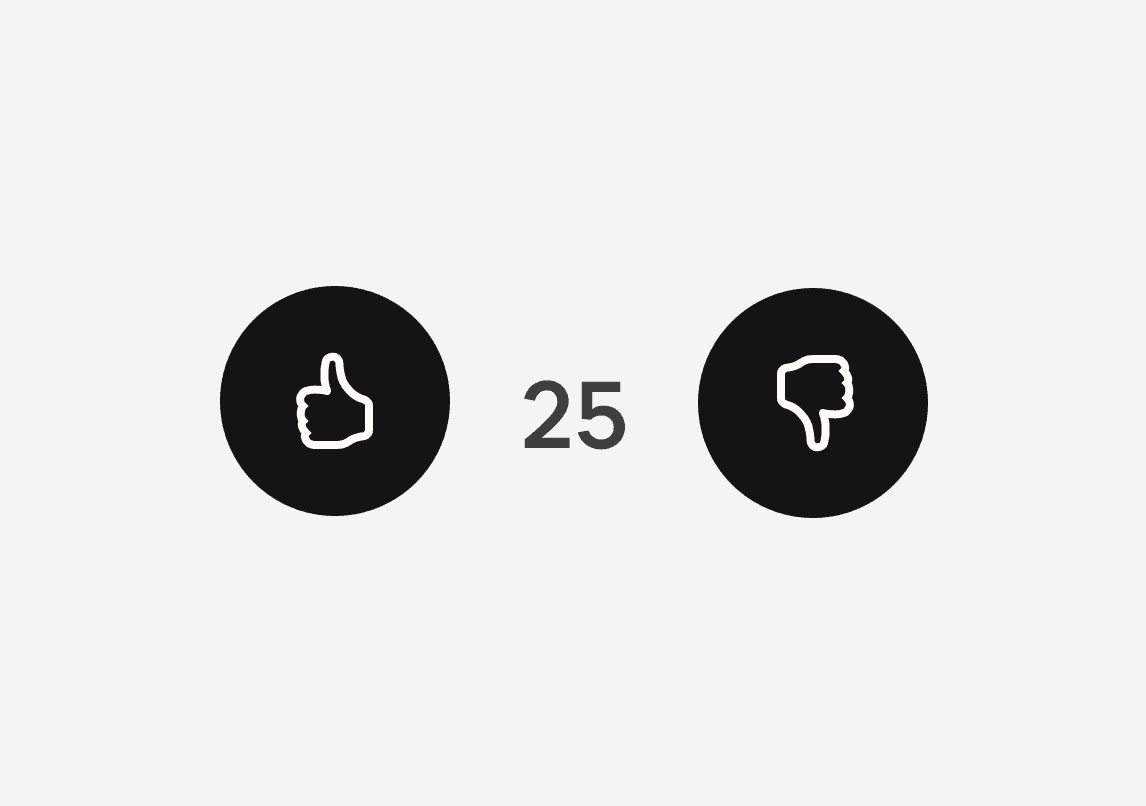

Another consideration for the design proposal was the interaction model. One approach, was the "YouTube" interaction model where negative signals are private and don't affect like counts. The other approach is the "Reddit" interaction model where negative signals publicly affect the like count. We decided that a private negative signal would work best for our product based on safety and brand considerations.

Iconography as proxy for user intent
I led the exploration of three iconographic directions for communicating negative feedback: hand-based, arrow-based, and heart-based symbols.
I framed each direction against our design principles and evaluated each for clarity, interaction familiarity, and alignment with Instagram’s brand.
To align the team, I facilitated cross-functional discussions to surface concerns and clarify tradeoffs. After this alignment effort, I was able to build consensus around prioritizing heart-based iconography for further experimentation. This direction offered an opportunity to extend Instagram’s familiar interaction language without adopting the more explicitly negative associations of traditional dislike symbols.
Hand-based symbols
We considered the thumbs-down icon since it offers an immediate and cross-cultural recognizable way to convey negative feedback.
Arrow-based symbols
We considered the arrow icons since their indicators for direction (e.g., down or up) can metaphorically suggest lowering and subtly signal disapproval.
Heart-based symbols
We explored a heart-based symbol for signaling negative perception, and agreed on inverting or breaking the metaphor of love could best convey the feature's functionality until we have more data on how users might prefer to signal disapproval.


Responding to internal concerns
As I socialized the heart-based interaction concept with cross-functional stakeholders, a recurring concern emerged: could introducing negative feedback encourage bullying, coordinated harassment, or other antagonistic behaviors on Instagram?
Rather than treating these concerns as objections to the concept, I used them to guide the design direction. I worked with the broader team to translate these risks into three product safeguards: private feedback, intentional onboarding, and creator controls aimed at preserving the utility of negative sentiment signals without compromising Instagram's broader social experience.
Making negative feedback private
To reduce the potential for public shaming and coordinated negativity, we explored an interaction model in which negative feedback would remain private. Unlike publicly visible dislike counts, this approach would allow users to express dissatisfaction without exposing commenters to a visible measure of disapproval.
Our competitive research reinforced the importance of keeping negative feedback private. In 2021, YouTube made dislike counts private after experiments demonstrated that public counts could encourage coordinated dislike attacks, disproportionately affecting smaller creators. Drawing on this precedent, we explored a model that preserved the utility of negative feedback without introducing a public measure of disapproval that could incentivize harassment.
Establishing intent through first-time education
I proposed introducing a first-time user experience (FTUX) to establish how and why the feature should be used. Rather than relying on iconography alone to communicate intent, I partnered with our content designer to develop messaging that positioned the interaction as a way to identify unhelpful comments, rather than express hostility or disagreement. This gave us an opportunity to shape user expectations before their first interaction.
Giving Creators Greater Control
Recognizing that attitudes toward negative feedback would vary across creators and communities, I proposed a post-level setting that would allow creators to disable the feature. This introduced flexibility into an otherwise universal interaction, giving creators greater agency over how their audiences engaged while allowing Instagram to experiment with the feature across different social contexts.
Shifting to UXR
After we clarified our proposal, our PM made the call to conduct UXR before we committed the team to a full production experiment. Looking back this was a prudent decision. For a feature with a non-trivial likelihood of generating public controversy, releasing it as an experiment too early could generate backlash or confusion before we have a chance to understand what may actually be beneficial.
Connecting with creators across demographics and regions
I was able to secure resourcing for one user researcher and we worked closely to develop the research plan. Our research methodology was as follows:

60-minute remote interviews via Zoom
Participants uploaded 3 screenshots of “bad” comments for discussion during interview.

36 participants from key markets
36 Instagram users from the US, Brazil, and India (key markets) who recently experienced a negative comment (12 adults, 12 teens, and 12 creators-various ages)

Concept tested Dislikes product
Concept tested prototype, allowing participants to explore a new signal indicating whether a comment is negatively affecting their experience.

Learnings and reflection
Our research didn't provide a strong enough signal that we should pursue dislikes, at least from a safety perspective. However, it did provide two insights that we did find useful for other initiatives.
Finding 1
There were two types of “bad” comments that primarily led to negative experiences on Instagram, with one type being perceived as more prevalent and harmful to users.
We used this finding to persuade safety senior leadership to shift product strategy to focus on identifying and reducing the most prevalent and harmful comments rather than all comments perceived as negative.
Finding 2
While all users had ways of dealing with bad comments, Creators and teens seemed to be the most negatively affected in terms of emotional impact and their engagement on Instagram.
This finding influenced the team to adjust our roadmap for evolving a machine leading (ML) model that identifies and reduces the most prevalent and harmful comments affecting teens and Creators.
Reflection
Leading this initiative reinforced my belief in design’s ability to open up new possibilities, even when the work doesn’t ultimately ship. Working closely with my PM and Policy partners challenged me to think beyond the immediate user experience and consider how a feature might be perceived by the broader public or produce reputational consequences we hadn't intended.
Back to top.